
Know the Knower
By Nabaghan Ojha
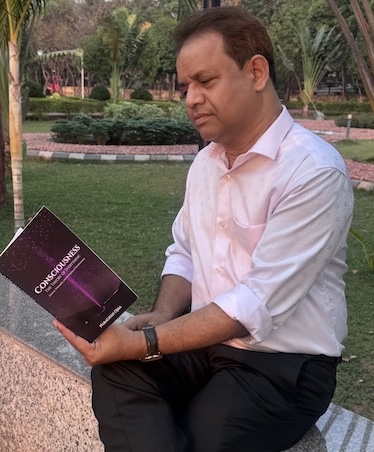
Author of Consciousness: The Theory of Everything
Published: 13th January 2026
We spend our lives trying to understand the world—its laws, its patterns, its problems. We analyze matter, decode the brain, map the universe, and now even attempt to replicate intelligence through machines. Yet amid all this inquiry, one question remains strangely absent:
Who is the one that knows?
Every experience—thought, emotion, perception, memory—appears before something that is aware of it. We see objects, but we rarely turn attention toward the seer. We examine thoughts, but we seldom inquire into the thinker. We seek knowledge endlessly, yet overlook the knower who makes knowledge possible.
This oversight is not accidental; it is habitual.
Modern thinking is trained to move outward, toward objects. Science excels at studying what can be measured, observed, and quantified. But the knower—the awareness by which all measurement and observation occur—cannot be placed under a microscope. It is not an object among objects. It is the silent presence in which all objects appear.
Indian philosophical traditions recognized this long ago. Instead of asking, “What exists?”, they asked, “Who is the one who knows existence?” This subtle shift changes everything. When inquiry turns inward, it becomes clear that the body is known, the mind is known, and even thoughts about the self are known. Therefore, none of these can be the knower itself.
The knower is not the body that ages, nor the mind that fluctuates. It is the unchanging awareness that witnesses both.
This is what we call consciousness—not as a product of the brain, but as the ground in which the brain, the mind, and the world appear. Consciousness does not come and go with experience; experience comes and goes within consciousness.
When this is not seen, life is lived in fragmentation. We identify with limited forms and live in constant fear—fear of loss, failure, and death. When the knower is understood, a quiet stability emerges. One realizes that while experiences change, the awareness in which they occur remains untouched.
This understanding does not negate science or reason. On the contrary, it completes them. Neuroscience can describe how experiences correlate with brain activity, but it cannot explain why experience exists at all. Physics can describe the universe with extraordinary precision, but it remains silent about the experiencer of the universe. These are not flaws; they are boundaries pointing toward a deeper inquiry.
To know the knower is not to acquire mystical beliefs or escape the world. It is to see clearly. From this clarity arises responsibility, compassion, and balance. Life is no longer lived as a struggle for identity, but as an expression of understanding.
The invitation is simple, though not easy:
Before trying to change the world, know the one who experiences it.
In knowing the knower, life begins to make sense—not as an idea, but as lived reality.
Article comments